
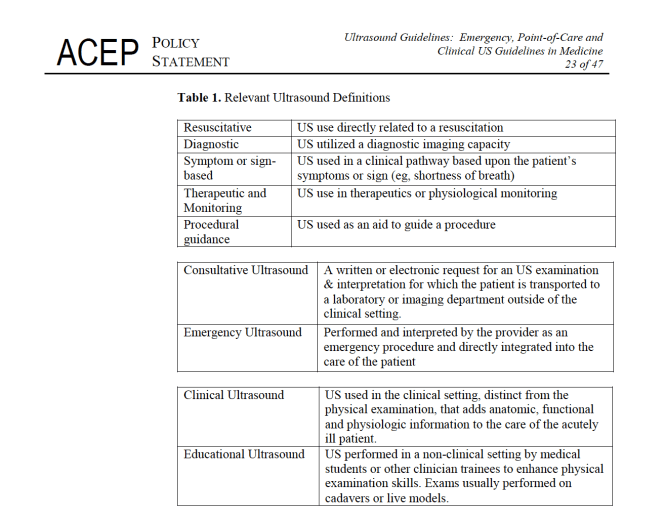
Point of Care Ultrasonography (POC-US) is being recognized as an adjunct to musculoskeletal assessment in hemophilia care. It fits into the realm of usage by the physiotherapist to enhance the joint and muscle assessment which is the core of the physiotherapy evaluation. Ninety percent of the bleeding due to hemophilia occurs in the musculoskeletal system, with 80% occurring in the joints. Therefore, POC-US adds value to the assessment as it is available to answer the clinical questions which arise such as, “Is this synovial swelling or actual blood in the joint?”, “Is this pain arthritis or an active joint bleed?” Answers to these clinical questions guide appropriate treatment options, enhancing the team discussion and leads to an appropriate care plan.
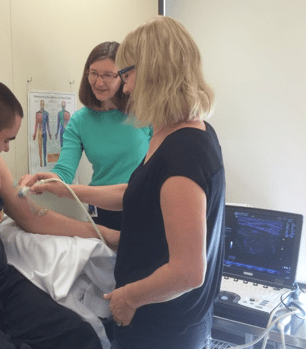
This intervention also has the capacity to act as a teaching tool. The client having this bedside education involving a picture of exactly what is occurring in their tissues (muscles or joints), allows for an enhanced conversation on appropriate treatment options. Therefore the next steps to developing an action plan are often met with more involvement of the client.
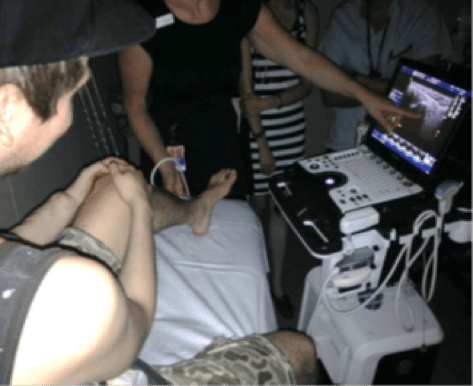 Physiotherapists need education and training to provide this enhanced assessment with the use of POC-US. A specialized course in POC-US for hemophilia physiotherapists was developed at McMaster University and Mohawk College in Hamilton Ontario. JoAnn Nilson, physiotherapist for the Saskatchewan Bleeding Disorders Program (SBDP) completed this course in December 2015. Andrea Willenborg, also a physiotherapist, will take the course Dec. 10-11, 2016. A published article highlights the program from Mohawk College (Strike et al., 2015). The SBDP purchased a portable ultrasound machine in June 2016. Enhanced assessment with the use of POC-US is now being offered to answer clinical questions during the musculoskeletal evaluations.
References to support the use of ultrasound in Hemophilia care.
1. Point of care ultrasonography in haemophilia care: recommendations for training and competency evaluation (pages 828–831)
K. L. Strike, A. Iorio, S. Jackson, W. Lawson, L. Scott, S. Squire and A. K. Chan Article first published online: 24 JUL 2015 | DOI: 10.1111/hae.12767
2. Point-of-care ultrasonography
K. L. Strike and S. Squire. Hemophilia Today, Nov. 2016, Vol 51, No 3 (page 11). http://www.hemophilia.ca/files/HT%20November%202016%20-%20final.pdf
JoAnn Nilson
Saskatchewan Bleeding Disorders Program
Royal University Hospital
Saskatoon, Saskatchewan
Email: joann.nilson@saskatoonhealthregion.ca
Sandra Squire
BC Bleeding Disorders – Adult Division
St. Paul’s Hospital
Vancouver, BC
Email: ssquire@providencehealth.bc.ca
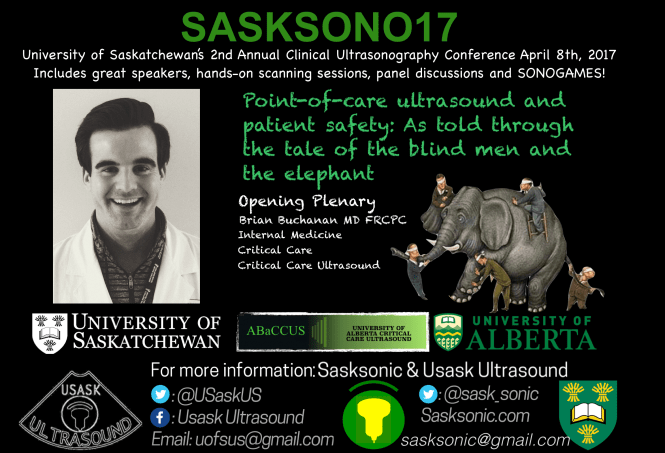





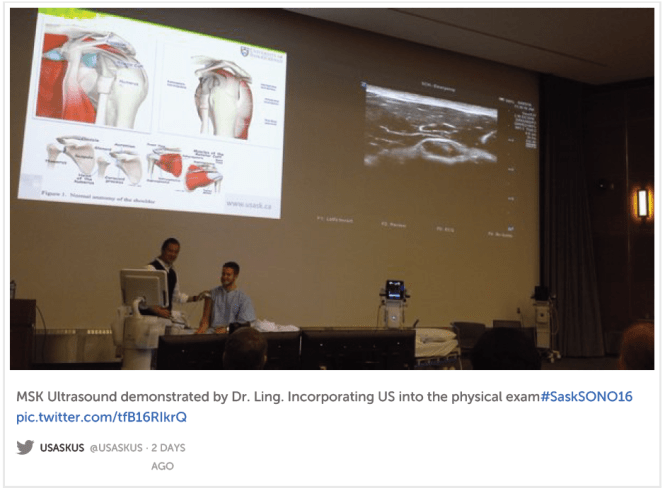 With great student turn out, and help from our faculty and residents, our first ever sono symposium was a HUGE success.
 Welcome to Sasksonic - a virtual hub for Point of Care Ultrasound at the University of Saskatchewan